Most entrepreneurs launching an online store think of terms and conditions as a document they put on their website because everyone else has one, a formality, not a priority.
This perception is costly. Sometimes a few thousand euros. Sometimes more.
Terms and conditions are not the document that protects the consumer. They are the document that protects you, the merchant. They are your contract with every customer, the document you refer to when a customer claims they ordered something different, when they refuse to follow your return procedure, or when they file a complaint with ANPC.
Without correct terms and conditions, you are defenceless.
What actually happens when you have no T&Cs or when they are wrong
The consequences of missing, copied, or incorrect terms and conditions are not abstract. Here is what happens in practice.
You lose disputes with consumers
When a customer takes you to court or files a complaint with ANPC, the first question is: what do the terms and conditions say? If you have no T&Cs or if your T&Cs do not cover the situation in question, the court or authority applies the legal provisions directly, which are always more favourable to the consumer than any clause you could have included.
A merchant without T&Cs or with incomplete T&Cs enters every consumer dispute from a position of weakness.
You are forced to accept returns you could have refused
The 14-day right of withdrawal is a legal right, but it has exceptions. Personalised products, perishable goods, hygiene-sealed products, digital content downloaded with the customer’s consent, all of these can be exempt from the right of withdrawal, if the exemption is correctly stated in the T&Cs and accepted by the customer before the order.
If you do not state it, the exemption does not apply. The customer can return the product and request a refund, even if you could legally have refused.
You receive fines from ANPC
ANPC sanctions merchants who fail to meet pre-contractual information obligations, meaning they do not communicate to the customer before the order everything the law requires them to communicate. This information is typically conveyed through the terms and conditions displayed on the website.
Fines for failure to meet information obligations can be significant, and may be accompanied by an obligation to publish the sanction, with a direct impact on the store’s reputation.
You cannot prove the customer accepted the contract
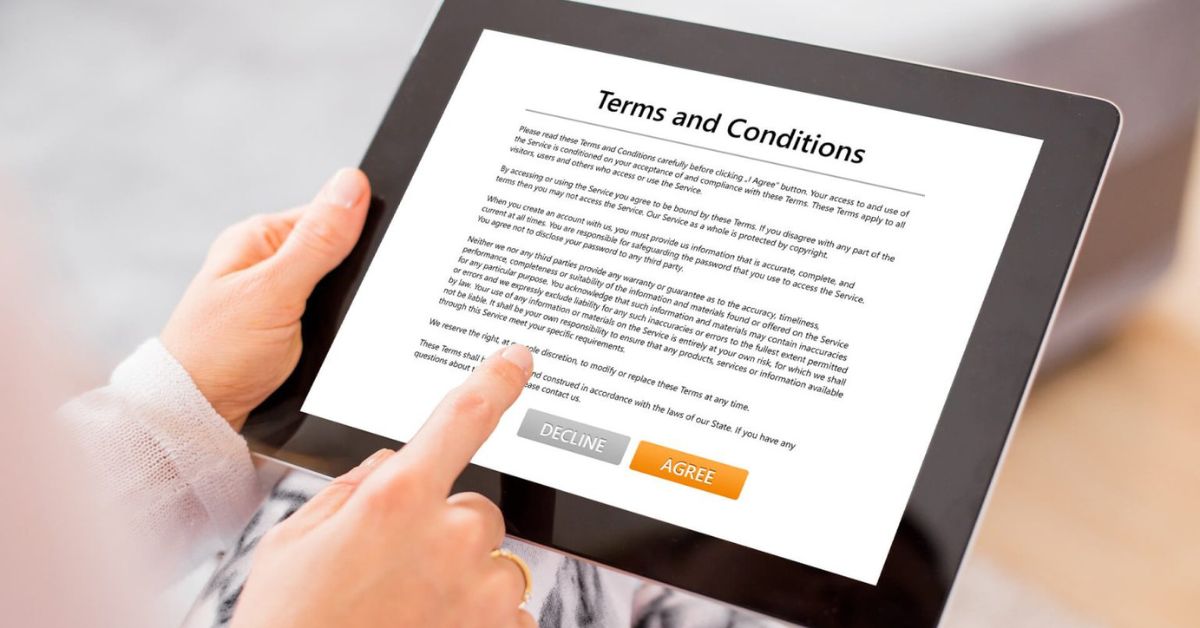
An online consumer contract is valid if the customer accepted it explicitly before placing the order. If you do not have a correct acceptance mechanism, a separate checkbox, not merely browsing the website, you may end up unable to prove that the customer was informed and accepted your terms.
Without proof of acceptance, your T&Cs are worthless in court.
The categories of clauses every online store must have
I will not go into the technical details of each clause, that is your lawyer’s job. But the overall picture of the mandatory categories shows just how complex the issue really is.
A complete set of T&Cs for an online store must cover the merchant’s identity and contact details, description of products and services, prices and payment methods, delivery conditions and timelines, the right of withdrawal and return procedure, the legal guarantee of conformity and any commercial warranty, the merchant’s liability and its limits, the dispute resolution mechanism, applicable law and competent jurisdiction, and the processing of personal data in the context of the order.
Each of these categories has particularities that depend on the type of products, the business model, and the markets you sell to. A set of T&Cs copied from another website cannot cover the specificities of your business, and may contain clauses that are illegal or unenforceable in your specific situation.
The most common mistakes Romanian online merchants make
In over 25 years of practice and working with numerous e-commerce clients, I have seen the same mistakes repeated. Here are the most frequent ones.
T&Cs copied from another website
This is the most common and most dangerous mistake. Copied T&Cs may contain clauses that do not apply to your business model, may be missing mandatory clauses for your type of products, may contain unfair terms that are void by law, may be legally outdated if the source website has not updated its documents recently, and may create confusion with other companies if the other firm’s name was left in the text.
I have seen T&Cs that mentioned a different company name, a different address, and different products from those sold on the website. A customer reading them could not tell who they were contracting with.
The right of withdrawal handled superficially
The 14-day right of withdrawal is one of the most complex topics in consumer law, and the most frequently handled incorrectly. Merchants either do not mention it at all, mention it incorrectly, or do not include the applicable exceptions for their type of products.
The consequence: they accept returns they could legally have refused, or conversely, they refuse returns the customer is entitled to and end up before ANPC or in court.
Unfair terms included without knowing it
The legislation on unfair contract terms, Law 193/2000 and EU Directive 93/13, contains a list of clauses that are presumed unfair or automatically void in consumer contracts. Many merchants include such clauses without realising it, because they copied them or because they seem reasonable from a business perspective but are illegal in the consumer relationship.
Typical examples: clauses that entirely exclude the merchant’s liability for defective products, clauses that allow the merchant to unilaterally change the price after the order without the customer’s right to cancel, clauses that impose on the consumer complaint deadlines shorter than those provided by law.
An unfair term is void by law, it produces no legal effects, regardless of whether the customer signed or ticked the acceptance box.
T&Cs for physical products applied to digital products
A store selling both physical products and digital products, software, online courses, ebooks, subscriptions, cannot use the same set of T&Cs for both categories. The applicable rules are significantly different, particularly regarding the right of withdrawal and warranties.
Digital products and SaaS — a separate chapter
If you sell software, subscriptions, online courses, or any other digital product, terms and conditions for physical products are not sufficient for you, and can create serious problems.
The main differences from physical products concern the right of withdrawal and the exceptions applicable to digital content delivered immediately, the legal nature of the relationship, usage licence versus sale, access conditions and account suspension terms, refund policy for subscriptions, liability for service unavailability, and personal data processing in the context of platform use.
Each of these aspects requires specific clauses that are not found in standard T&Cs for physical goods online stores. A SaaS platform or online course provider using generic T&Cs is exposed to significant legal risks that they often do not even realise exist.
How to tell if your T&Cs have a problem
You do not need to be a lawyer to identify the warning signs. Here are five situations that indicate your T&Cs need urgent review.
Warning sign 1: You copied them from another website more than 2 years ago and have not updated them since. The legislation has changed, your business model has changed — your T&Cs probably no longer reflect either.
Warning sign 2: You do not know exactly what they say. If someone asks you a question about your return policy or warranty and you cannot answer without searching through the document, the T&Cs are not truly yours.
Warning sign 3: You have already had a dispute or an ANPC complaint. If you have been through a consumer dispute, it is time to check whether your T&Cs would have protected you — and to correct them before the next dispute.
Warning sign 4: You sell on multiple markets or have customers from other EU countries. T&Cs for the Romanian market do not automatically cover requirements in other member states. Cross-border selling within the EU brings additional obligations.
Warning sign 5: You have added new products or services without updating your T&Cs. Each new category of products or services may bring new legal obligations not covered by your existing documents.
This article is for general informational purposes only and does not constitute legal advice. Terms and conditions for an online store must be tailored specifically to the type of products, business model, and markets you sell to. For a review of your existing documents or for T&Cs drafted to match your specific situation, contact a specialist lawyer.
Frequently Asked Questions
Can I use an online T&C generator? An online generator can produce a starting point document, but cannot replace T&Cs tailored specifically to your business. Generators produce generic documents that do not know your product type, business model, or the markets you sell to. Mandatory clauses for your specific situation may be missing, or inapplicable clauses may be included. If you have used a generator, it is advisable to have the document reviewed by a lawyer before relying on it.
How often should T&Cs be updated? Whenever something relevant changes, the applicable legislation, your business model, the types of products or services offered, the markets you sell to, or your commercial practices. As a general rule, an annual review is recommended even in the absence of obvious changes.
Do customers actually read T&Cs? Most do not read them before purchasing. But they do read them when a problem arises, when they want to return a product, when they are unhappy with delivery, or when they want to file a complaint. At that point, your T&Cs either protect you or they do not.
What happens if I have T&Cs but the customer claims they did not see them? This is why the acceptance mechanism is just as important as the content of the T&Cs. If you cannot prove that the customer accepted the T&Cs before placing the order, through a separate checkbox, not merely by browsing the website, the document may be unenforceable against the customer in court.
I have a small store with few customers. Do I really need professional T&Cs? Yes. ANPC does not sanction proportionally to store size, a fine can be imposed on a store with 10 orders a month just as easily as on one with 10,000. And a single consumer dispute can cost more than having a correct set of T&Cs drafted in the first place.
Want to check whether your online store’s T&Cs are compliant or need T&Cs drafted specifically for your business?
Request a Legal Assessment: we respond within 24 hours on business days.
[ Request Legal Assessment ] [ +40 720 530 400 ]